

For a shelf held out from a wall on brackets alone, the arm under the shelf should reach at least two-thirds of the shelf’s depth: about 8 inches for a 12-inch shelf, 7 inches for a 10-inch shelf and 5-1/2 inches for an 8-inch shelf. Go a size longer for heavy things. The leg on the wall needs room for at least two screws, into studs where you can reach them. A small 2.5-inch bracket like BINKIN’s is for a different job: shelves held at their ends inside a cabinet, alcove or shelving bay, and ledges a few inches deep.
Bracket size by shelf depth
| Shelf depth | Arm under the shelf, at least | Common bracket size |
|---|---|---|
| 6″ | 4″ | 4″ |
| 8″ | 5-1/2″ | 6″ |
| 10″ | 7″ | 8″ |
| 12″ | 8″ | 8″, or 10″ for heavy things |
| 14″ | 9-1/2″ | 10″ |
| 16″ | 11″ | 12″ |
The rule is for a shelf held up only by brackets on a wall. The arm under the shelf does the holding, and the further it reaches toward the front edge, the less the front of the shelf can tip or sag. Books, tools and paint cans call for a longer arm and load-rated shelf brackets.
The leg on the wall
- Long enough for at least two screws, so the bracket cannot pivot.
- Into studs where you can reach them, usually 16 inches apart, or wall anchors rated for the load where you cannot.
- At least two brackets per shelf, one near each end, and one on every stud for a long or loaded shelf. See how to install shelf brackets.
Where a small 2.5-inch bracket fits
BINKIN’s bracket has a 2.5-inch slotted leg and a 0.625-inch short leg. That short leg is not a shelf-depth arm, so it is not the bracket for holding a deep shelf out from a wall on its own. It does these jobs well:
- Shelves between two sides: inside a cabinet, an alcove or a bay of a shelving unit, a bracket near the front and back of each side holds the shelf’s ends, with the slotted leg on the side so you can slide each one level.
- Ledges and box shelves a few inches deep: picture ledges and box shelves, with the bracket behind or under them where it does not show.
- Leveling: on an uneven wall, the 2-inch slot lets each bracket slide up or down after the first screw is in. See how to level a shelf.
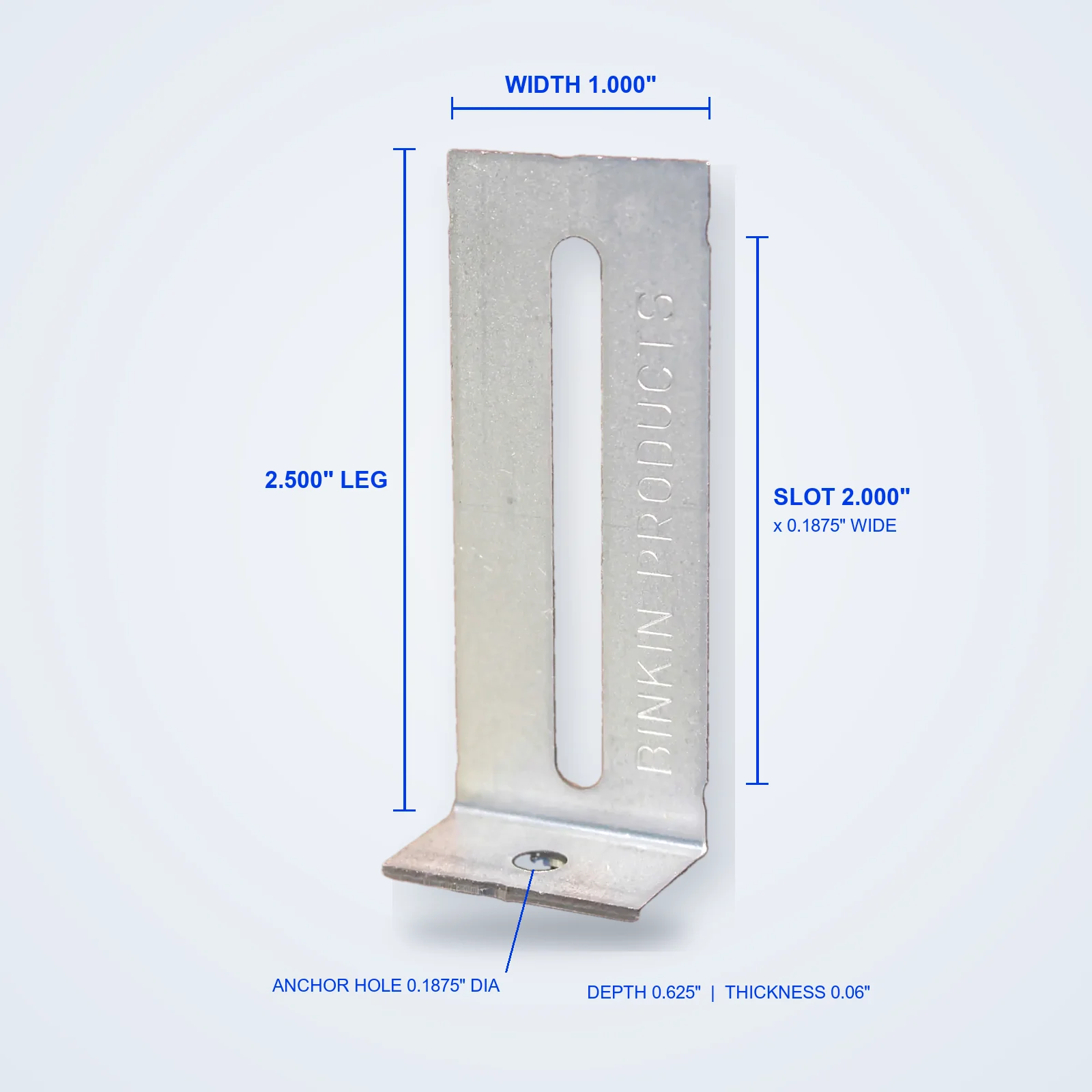
Small brackets are light-duty hardware. How much any shelf holds depends far more on the screws, the studs or anchors, and the shelf itself than on the steel. BINKIN does not publish a load rating. For heavy loads, use load-rated shelf brackets made for the job.
Questions people ask
What size L-bracket for a 12-inch shelf?
For a 12-inch shelf held out from a wall on brackets, an arm of at least 8 inches under the shelf, and 10 inches for heavy things.
What size bracket for a 10-inch shelf?
An arm of at least 7 inches. An 8-inch bracket is the common size to buy.
What size bracket for an 8-inch shelf?
An arm of at least 5-1/2 inches. A 6-inch bracket is the common size to buy.
What size L-bracket do I need?
For a shelf on a wall, take two-thirds of the shelf’s depth for the arm under it, and make sure the wall leg takes at least two screws. For other jobs, see how L-brackets are measured.
Can I use BINKIN brackets for a 12-inch shelf?
Inside a cabinet, alcove or shelving bay, where brackets on both sides hold the shelf’s ends, yes. Held out from a single wall on brackets alone, a 12-inch shelf needs an arm of about 8 inches, and BINKIN’s short leg is 0.625 inch.